
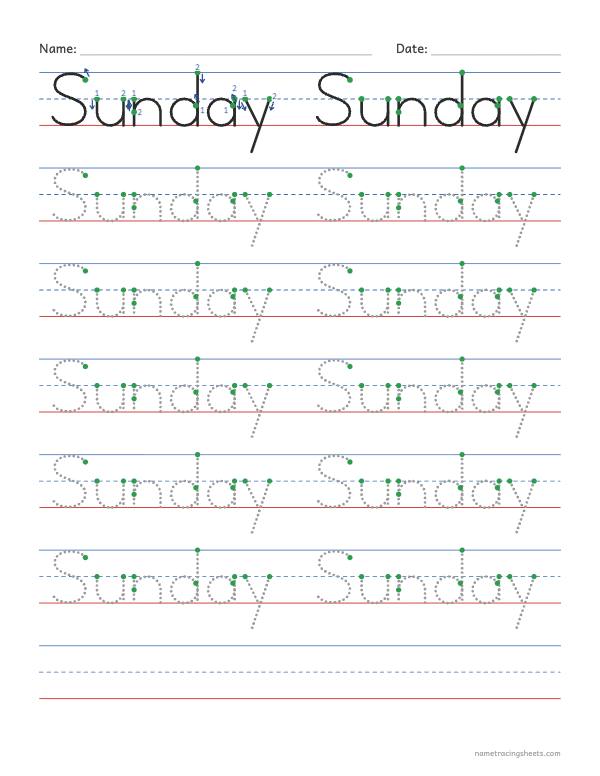
How to print days of the week worksheets
- Start with the days. The page opens with Sunday to Saturday, one day per page, in the order most US calendars use.
- Or pick another set. Months of the year gives twelve pages, January to December. Day abbreviations and Month abbreviations give the short forms seen on calendars and planners. Calendar words gives today, yesterday, tomorrow, week, month and the other words of a morning calendar routine.
- Choose letters and size. Print, D'Nealian or cursive. Large lines suit kindergarten; medium suits first and second grade, where Wednesday and September still fit several times on a line.
- Print the set. Every page prints in one go, or save it as a PDF to reuse each week.
The seven days of the week
In order, with the short form used on calendars, the number of letters to write, and where each name comes from:
| Day | Short | Letters | Named after |
|---|---|---|---|
| Sunday | Sun | 6 | the sun |
| Monday | Mon | 6 | the moon |
| Tuesday | Tue | 7 | Tiw (Týr), an Old English and Norse god |
| Wednesday | Wed | 9 | Woden (Odin) |
| Thursday | Thu | 8 | Thor |
| Friday | Fri | 6 | Frigg, Odin’s wife |
| Saturday | Sat | 8 | Saturn, the Roman god |
The twelve months of the year
In order, with the three-letter short form, the number of days, and where each name comes from:
| Month | Short | Days | Named after |
|---|---|---|---|
| January | Jan | 31 | Janus, the Roman god of doorways and beginnings |
| February | Feb | 28 (29 in a leap year) | Februa, a Roman festival of cleansing |
| March | Mar | 31 | Mars, the Roman god of war |
| April | Apr | 30 | probably the Latin aperire, to open, as buds do |
| May | May | 31 | Maia, a Roman goddess of growth |
| June | Jun | 30 | Juno, the Roman queen of the gods |
| July | Jul | 31 | Julius Caesar |
| August | Aug | 31 | Augustus, the first Roman emperor |
| September | Sep | 30 | Latin septem, seven: it was the seventh month of the early Roman year |
| October | Oct | 31 | Latin octo, eight |
| November | Nov | 30 | Latin novem, nine |
| December | Dec | 31 | Latin decem, ten |
Words that are hard to spell
- Wednesday has a d that is not said: it sounds like Wenz-day. Splitting it into Wed-nes-day while tracing helps the letters stick.
- February is often said Feb-yoo-ary, so children leave out the first r. Trace it slowly and say every letter.
- Thursday and Saturday share the ur sound, spelled ur in both.
- Tuesday uses ue, not oo.
- August and autumn both start with au, a pair worth pointing out.
Every day and every month starts with a capital letter, even in the middle of a sentence. The abbreviations keep their capital too: Mon, Tue, Jan, Feb.
A rhyme for the days in each month
The old rhyme still works for remembering which months are short:
Thirty days has September, April, June and November. All the rest have thirty-one, except February alone, which has twenty-eight days clear, and twenty-nine in each leap year.
Another way is the knuckle trick: make two fists and count the months across the knuckles and the dips between them. Every month on a knuckle has 31 days; every month in a dip has 30, or fewer for February.
Ideas for using the pages
- One day, on its day. Trace Monday on Monday, Tuesday on Tuesday. After a week the child has written all seven and seen them in order.
- Calendar time. Use the Calendar words set alongside a classroom calendar: today is, yesterday was, tomorrow will be.
- Birthday month first. Start the months with the child's own birthday month, then the current month.
- Order the pages. Shuffle the printed days or months and ask the child to put them back in order before tracing.
- Short forms later. Abbreviations make more sense once the full words are known, usually in first or second grade, when children read planners and dates.
More word worksheets
Color words, number words, shape words and family words are on the word tracing worksheets page. For a sentence like Today is Monday. to trace and copy, type it into the handwriting worksheet generator or use the kindergarten writing worksheets. For the numbers on a calendar, use the number tracing worksheets with 1–31.