How it works
- Pick a sentence set or type your own. The buttons above the box fill it with four short sentences: I see…, I like…, I can…, an About me set, short vowel words, and fall or winter sentences. Put one sentence on each line. At the large size a line holds three or four short words; a longer sentence wraps onto a second line.
- Check the size. The page opens at large, the size most kindergartners write at. Use extra large early in the year, medium once the letters sit neatly on the lines.
- Print, save as PDF or download PNG. At the large size each page holds two sentences, so four sentences make two pages.
Under More options you can turn off the solid example, add a second empty line after each sentence, switch to gray guide lines, or remove the name and date line.
What kindergarten writing looks like over the year
Most children move through the same steps, each at their own pace. It helps to know where a child is before picking a worksheet:
- Their name. Usually the first word a child writes, often in all capitals at first. The name tracing worksheet generator makes a page from any name.
- Letters. Capitals first, then lowercase, with the right starting point and direction. The letter tracing worksheets cover A to Z.
- Words. Short words such as cat, dog and red, and sight words such as the, see and like. Try the word tracing worksheets and the kindergarten sight words.
- Sentences. Three to six words with a capital at the start and a period at the end. This page is for this step, and for children getting close to it.
Many children start writing sentences in the second half of kindergarten. A child still working on letters in the spring is not behind; give them more letter and name pages and come back to sentences later.
Capitals, periods and finger spaces
Short sentences are where three small rules come in. Say them out loud while the child traces:
- A capital letter at the start. I is always a capital, even in the middle of a sentence, which is one reason sentences that start with I are a good first step.
- A finger space between words. The child puts the pointer finger of the other hand on the line after each word, then starts the next word on the far side of it. The traced sentences already have the spaces, so tracing shows how wide a space is.
- A period at the end. Point to it and say "stop" when you read the sentence together.
Lowercase letters such as a, c and e sit between the baseline and the dashed midline. Tall letters such as d, h, k and l reach the top line, and g, j, p and y drop below the baseline.
How to use trace, then copy
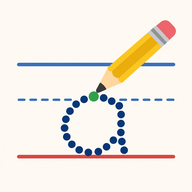
Each sentence takes three lines on the sheet: a solid example, a dotted line to trace, and an empty line to write it again.
- Read it first. Point to each word on the solid line and read the sentence together.
- Trace it. Start each letter at the green dot and say the word while tracing it.
- Copy it. Write the sentence on the empty line below, looking back up as often as needed. Uneven copies are normal; the point is to try every letter without help.
- Read it back. The child reads their own sentence aloud and checks for the capital, the spaces and the period.
When copying gets easy, turn off the solid example, then set the empty lines to two and let the child write the sentence again with one word changed: I like my dog becomes I like my cat.
A weekly kindergarten writing routine
Five to ten minutes a day is plenty at this age. One way to fill a week:
- Monday: print one sentence set, then trace and copy the first two sentences.
- Tuesday: the other two sentences.
- Wednesday: print the same set again. The second time through is when it starts to feel easy.
- Thursday: the child picks a word to change in each sentence, and you type the new sentences in.
- Friday: the child tells you a sentence about their week, you type it, and they trace and copy their own words.
Keep the sheets in a folder. Comparing a page from September with one from March is the clearest way to see progress.
Which size to pick
The line sizes match the grades they are usually used in: extra large for preschool, large for pre-K and kindergarten, medium for kindergarten and first grade, small for second grade. Large is the default here. Move to medium once the child's letters fit the large lines without spilling over; medium fits more sentences on each page.
For more writing practice, the handwriting worksheet generator takes any text at any size, and primary writing paper gives empty lines, with an optional picture box on top for a drawing and a sentence about it.