How it works
- Pick a line size. Extra large for 3 and 4 year olds, large for pre-K and kindergarten, medium for first grade and small for second grade.
- Pick the paper. US Letter or A4. Landscape is under More options.
- Choose how many pages. From 1 to 10. Every page is the same, so a stack is ready for the week.
- Add a picture box if you like. Tick Picture box at the top and the top of each page becomes an empty frame for drawing, with the lines below it.
- Print, save as PDF or download PNG.
Under More options you can switch the red and blue lines to gray for a black and white printer, and turn the name and date line on or off.
Who uses primary paper
Primary writing paper is the wide-ruled paper children use from pre-K to about second grade, while they learn how tall each letter should be. Kindergarten teachers use it for the first sentences of the year, first grade classrooms for journals and spelling, and parents and homeschool families for daily copywork. Occupational therapists use the larger sizes for children who need more room to form letters.
Children usually move to regular wide-ruled notebook paper in third grade, once their letters sit on the line without the dashed midline as a guide.
The three lines, explained
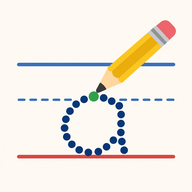
Each writing space has three lines, the same as on our tracing worksheets:
- The top line (blue) is where capital letters and tall letters such as b, d, h, k, l and t reach.
- The dashed midline is where small letters such as a, c, e, m, n, o and the hump of the h stop.
- The baseline (red) is where every letter sits. Many teachers call it the grass or the ground.
Letters with tails, such as g, j, p, q and y, drop below the baseline into the space before the next top line. That space is built into every row, so tails never run into the next line of writing.
Which line size for which grade
The sizes match the tracing worksheets on this site, so a child can move from tracing to writing on the same lines:
- Extra large: 1 inch from the top line to the baseline. For 3 and 4 year olds and children still building their grip.
- Large: 3/4 inch. Pre-K and kindergarten.
- Medium: a little over 1/2 inch. Kindergarten and first grade.
- Small: a little under 1/2 inch. Second grade.
If a child's letters keep crossing the top line, go one size up. If the letters look lost in the space, go one size down.
Story paper with a picture box
Story paper puts a drawing space above the writing lines. Children draw first and then write a sentence about the picture, which gives young writers something to say before they have to spell it. It works for journals, "what I did this weekend", science observations and retelling a book the class just read. With the picture box on, about the top 40% of the page becomes the box and the rest stays lined.
Printing tips
- In the print window, set the scale to 100% or Actual size and turn off Fit to page, so the lines print at the size you chose.
- Match the paper setting to the paper in your printer: US Letter in the US and Canada, A4 almost everywhere else.
- Gray lines print better on a black and white printer; red and blue look like classroom paper on a color printer.
- Slip a page into a clear sleeve and use a dry-erase marker to practice many times on one sheet.
When a child needs letters to trace rather than empty lines, use the handwriting worksheet generator for any sentence, the alphabet tracing worksheets for letters, or the name tracing worksheet generator for their own name.