How it works
- Tick the lines and shapes you want. All 18 are ticked to start with: eight kinds of lines and ten shapes. Untick the ones you do not need. Each one prints on its own page.
- Pick a tracing style. Dotted is the classic look, light gray is easiest for three year olds, and dashed prints darker on a pale printer.
- Pick a size. Extra large is the default and suits ages two to four. Smaller sizes fit more rows on a page for older children.
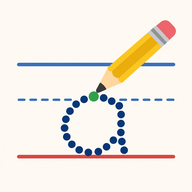
- Print or save as PDF. The first row of each page is solid, with arrows on the first shape. Every row has green starting dots.
Pre-writing strokes in the order children learn them
Occupational therapists use a well-known sequence for the shapes children can copy, from the Beery developmental test. Ages vary a lot, but roughly:
- Vertical line around age 2 to 3, then the horizontal line.
- Circle around age 3.
- Cross (+) around age 4.
- Slanted lines and the square around age 4 to 5.
- X and the triangle around age 5.
Tracing comes before copying, so a child can trace a shape on these pages a little before they can draw it alone. Start with the first lines in the list and add the next one when the earlier ones look steady.
Why lines come before letters
Every print letter is built from these strokes. The l and the t are vertical lines, the o and the c are circles, the k, v and w are slanted lines and the n and h are the curved bridges. A child who can pull a straight line down from a starting dot, or go around a circle the right way, already has most of what the alphabet needs.
The arrows teach the habits that matter later: lines go from top to bottom and from left to right, and circles start at the top and go around to the left, the same way the letters a, c, d and o start. When the strokes are steady, move on to the letter tracing worksheets or the child's own name on the name tracing worksheet generator.
Tips for little hands
- Trace each shape with a finger first, saying the direction out loud: down, across, around.
- Use a chunky crayon or a short pencil. Short tools encourage a better grip than long ones.
- Do one page a day, for a few minutes. Stop while it is still fun.
- Slip a page into a clear sleeve and use a dry-erase marker to practice the same page many times.
- Do not worry about staying exactly on the line. Starting at the dot and going the right way matter more.