Any range, one page per number
The box starts with 1-10, which prints ten pages, one for each number. Change it to 1-20, 11-20 or 0-5 and the pages update. You can also type numbers one per line, or put several on one line, such as 1 2 3 4 5, to practice them together on one page.
Each page shows the number in solid ink on the first line, then rows of dotted numbers to trace, repeated across the line.
Starting dots and stroke arrows
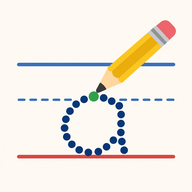
Numbers are drawn as single stroke paths, the way they are taught: the green dot shows where the pencil starts, and on the solid example the numbers and arrows show the order and direction of each stroke. A few that children often get wrong:
- 0 starts at the top and goes around to the left, counterclockwise, like the letter o.
- 4 is two strokes: down and across first, then the long line down.
- 5 is two strokes too: down and around the belly first, then the flag across the top.
- 8 starts at the top right and curves down like an S, then back up to the start.
- 9 is a small circle and a straight line down, not a backwards 6.
Reversed numbers, such as a backwards 3 or 7, are common up to about age seven. Starting each number at its dot is the simplest way to fix them.
A simple routine
- Pick two or three numbers for the week, in order: 1 to 5 first, then 6 to 10.
- Trace on extra large or large lines with light gray numbers for a few minutes a day.
- Switch to dotted numbers once the strokes start in the right place.
- Under More options, add empty lines at the end and let the child write the numbers alone.
- Count real things alongside: write 3, then find three spoons.
For letters, use the letter tracing worksheets, and for a child's own name the name tracing worksheet generator.