How to write a cursive capital S
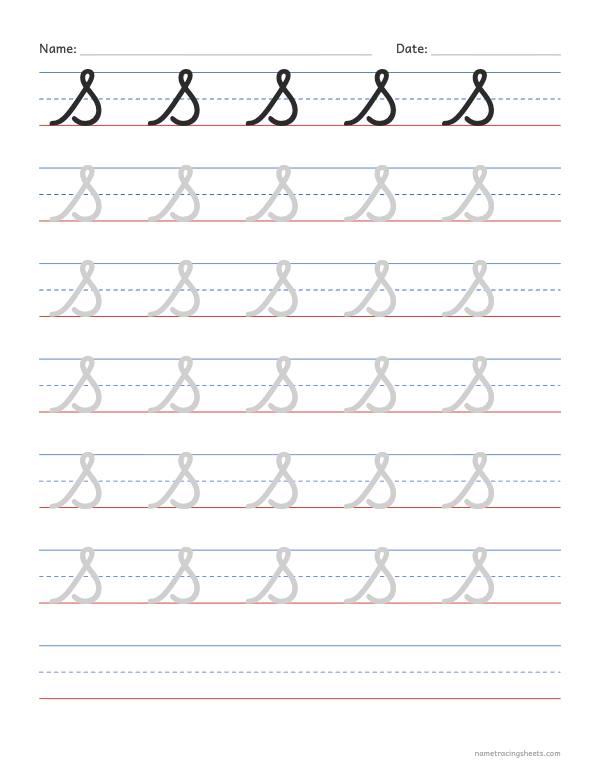
- Start at the baseline on the left and swing up to the top line.
- Make a small loop at the top and come down the right side in a curve.
- Round the bottom back to the left and end with a small curl on the left.
On these sheets the letter after capital S starts on its own.
How to write a cursive lowercase s
- From the baseline, swing up a little past the midline to a point.
- Curve down to the right and around to the baseline.
- Close back on the left at the baseline, then end with a curve up.
Joining cursive s to other letters
Lowercase s starts like r, with an upstroke to a point. After o and w, as in nose and was, the join leaves the midline and rises only a little, so the point is easy to lose. In ss, as in grass and kiss, the second s starts from the closed bottom of the first.
s leaves from the baseline after it closes. An s that does not close at the bottom looks like an r.
Cursive S and print S
Lowercase cursive s, with its point and closed bottom, looks nothing like the print snake shape. Capital S has a loop at the top and a curl at the bottom; it does not join the next letter.
Print S with starting dots and arrows: letter S tracing worksheets.
Cursive s words
sun, sock, seal, snake, grass.
Previous: cursive R. Next: cursive T. All 26 letters: cursive alphabet worksheets.