How to write a cursive capital G
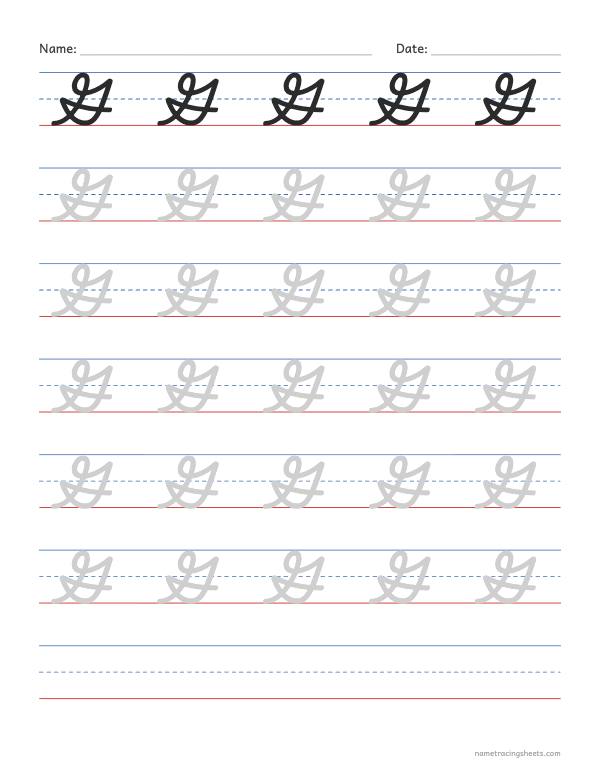
- From the baseline on the left, swing up to the top line and make a small loop there.
- Come down through the middle, curve around the bottom and climb the right side to the top.
- Pull back down the right side to the middle and finish with a short stroke across.
On these sheets the letter after capital G starts on its own.
How to write a cursive lowercase g
- From the baseline, swing up to the midline, curve back to the left and around to close a small oval, as for a.
- Pull a slant down the right side, below the baseline.
- Loop back to the left and up, crossing the slant at the baseline, and keep rising.
Joining cursive g to other letters
Lowercase g joins in like a: the stroke before it climbs to the midline and arches over the oval, as in ag and ig. After n, as in sing and long, the hump of the n flows straight into that arch.
g leaves from its lower loop with a stroke that rises through the baseline, the same exit as j, y and z. The loop should close right at the baseline; an open tail, like a print g, leaves the next letter starting below the line. gg in egg and giggle is good practice for it.
Cursive G and print G
Lowercase cursive g is close to print g with the hook closed into a loop. Capital G is the big change: a swirl with a loop at the top that many children read as an S.
Print G with starting dots and arrows: letter G tracing worksheets.
Cursive g words
go, gum, goat, grass, giggle.
Previous: cursive F. Next: cursive H. All 26 letters: cursive alphabet worksheets.